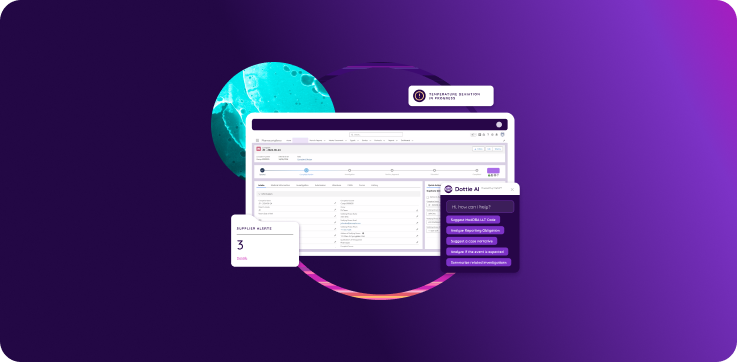
eQMS for Life Sciences: A Buyer’s Guide


Choosing an electronic quality management system (eQMS) is one of the most consequential technology decisions a life sciences company makes. The platform you select will sit at the center of your regulated operations for five to ten years, shaping how quickly you close CAPAs, how smoothly audits run, and how much time your quality team spends on administration versus actual quality work.
The challenge is that every vendor demo looks impressive, every feature checklist looks complete, and every sales deck promises end-to-end compliance.
This guide cuts through that noise. It covers how to evaluate an eQMS for pharmaceutical, biotech and medical device environments, including buying criteria, integrations, and the mistakes that derail eQMS projects most often.
What Is an eQMS?
An electronic quality management system is software that digitizes and connects the quality processes life sciences companies are required to run under GxP regulations. A complete eQMS typically manages:
- Document control with full lifecycle management (draft, review, approval, effective, obsolete)
- Training management linked to document changes and job roles
- CAPA, deviations, and nonconformance handling
- Change control
- Internal and external audit management
- Supplier quality and qualification
- Complaint handling and post-market surveillance links for device companies
The purpose is twofold: satisfy regulators (FDA 21 CFR Part 11, EU Annex 11, ISO 13485, and related GxP requirements) and replace fragmented paper or spreadsheet-based processes with connected, traceable workflows.

How to Evaluate an eQMS: Core Buying Criteria
1. Verified Regulatory Compliance
Compliance claims are easy to make and hard to verify from a slide. Confirm the platform provides time-stamped, tamper-evident audit trails on every record, Part 11-compliant electronic signatures, role-based access controls, controlled document distribution, and data residency options if you operate in regulated regions like the EU.
Then go beyond the checklist.
Ask how many customers have hosted FDA inspections or notified body audits inside the system, and request a reference call with one of them. Direct inspection experience is stronger evidence than any certification badge.
2. Usability for Occasional Users
Quality professionals will learn any interface. The users who determine success are the occasional ones: the production operator logging a deviation, the scientist routing a document once a quarter, the supplier responding to a corrective action request. If the system frustrates these users, they create workarounds, and workarounds create data integrity gaps.
Test this directly.
Put untrained end users in a sandbox environment with a realistic task and observe how far they get. Their experience predicts adoption better than any feature comparison.
3. A Unified Data Model
Many platforms have grown through acquisition, leaving seams between modules. Ask whether document control, CAPA, training, and supplier management share one platform and one data model. Then verify by tracing a single thread in the demo: a complaint that opens an investigation, which generates a CAPA, which drives a document change, which assigns training. If that chain breaks anywhere, you will be rebuilding it manually with exports and spreadsheets.
4. Scalability and Roadmap
Most companies begin with document control and training, then expand into CAPA, audits, supplier quality, and complaints. Confirm the modules you will need in three years exist today, and ask about the product roadmap, release cadence, and how customer feedback shapes development.
Validation: Questions That Separate Vendors
For GxP environments, validation is mandatory, and vendor approaches vary dramatically. Historically, computer system validation was the largest cost and schedule risk in an eQMS deployment, with teams spending months writing and executing IQ/OQ/PQ protocols.
Modern cloud vendors have changed this equation, but only some of them.
Key questions to ask:
What validation documentation is provided? Leading vendors supply pre-executed validation packages for the core platform aligned with GAMP 5, leaving customers responsible only for verifying their specific configurations and intended use. Ask exactly what is included and what your remaining effort looks like in concrete hours.
How are cloud releases handled? SaaS platforms update several times per year, and each release touches your validated state. Ask how far in advance release notes arrive, what regression testing the vendor executes and documents, and whether impact assessments are provided to scope your re-verification effort.
Is the approach risk-based? The FDA’s Computer Software Assurance (CSA) guidance supports risk-based validation rather than exhaustive script testing. Vendors whose validation model reflects current regulatory thinking will save you significant recurring effort.
Integrations: Making Quality Data Operational
A standalone eQMS stores compliance records. An integrated eQMS moves quality information to the systems and people who act on it, which shows up directly in faster investigation cycles and less manual re-entry.
Priority integrations for life sciences buyers include:
- ERP (SAP, NetSuite, Microsoft Dynamics) for supplier, material, and batch data
- LIMS so out-of-specification results flow into investigations automatically
- MES for production events feeding quality records in real time
- HRIS for automated user provisioning and training assignments
- Identity providers for single sign-on via SAML or OAuth
- Regulatory information management to link change control with product registrations
Evaluate the mechanics, not the logo wall. Confirm there is a documented, versioned REST API, ask who maintains pre-built connectors and what happens to them during upgrades, and request a reference customer running the specific integration you care about most.
Ask about AI capabilities and evaluate these features the way an auditor would: every AI output should be subject to human review and approval, your data should be protected, and AI-assisted steps should be documentable during an inspection.
Common eQMS Buying Mistakes to Avoid
Buying for the audit instead of the operation. Systems chosen purely for inspection readiness often neglect daily usability, which suppresses adoption and ironically undermines the compliance goal. Buy for the people who use the system every day; audit readiness follows from good data.
Skipping the sandbox. Scripted demos show what vendors want you to see. Insist on a trial environment loaded with your own SOPs and a realistic deviation scenario for your top two finalists. Two weeks of hands-on testing reveals more than ten demos.
Underestimating data migration. Legacy quality records are messier than anyone expects. Decide during evaluation what migrates, what gets archived, and how historical audit trails will be preserved, and get migration scoped and priced before signing.
Choosing a horizontal platform for a vertical problem. Generic workflow tools can be configured for quality management, but every regulatory control becomes your responsibility to build, validate, and maintain. Purpose-built life sciences eQMS platforms carry that regulatory logic natively, and the difference compounds over years.
Letting procurement drive requirements. Procurement and IT belong at the table for contracts, security, and architecture, but quality and operations must own the functional requirements. When cost-per-line-item drives the decision, total cost of ownership usually suffers.
A Structured Evaluation Process
- Document must-have processes and pain points in a two-page requirements summary
- Shortlist three to four vendors with proven customers at your size and regulatory profile
- Run structured demos built around your scenarios, not the vendor’s script
- Sandbox test your top two finalists with real documents and workflows
- Call references, including at least one customer who has hosted a regulatory inspection on the platform
- Model five-year total cost of ownership for both finalists
- Negotiate implementation scope, validation deliverables, and support SLAs into the contract alongside price
Frequently Asked Questions
What is an eQMS in life sciences?
An electronic quality management system is validated software that manages GxP quality processes, including document control, training, CAPA, deviations, change control, audits, supplier quality, and complaints, in a single compliant platform.
How is an eQMS different from generic workflow software?
A life sciences eQMS is purpose-built for requirements like FDA 21 CFR Part 11 and ISO 13485, with audit trails, electronic signatures, and validation support included. Generic tools require you to build and maintain those regulatory controls yourself.
Does an eQMS need to be validated?
Yes. Any system managing GxP records requires validation. Modern cloud vendors reduce the burden with pre-executed validation packages, leaving customers to verify their specific configuration and intended use.
Final Thoughts
The right eQMS does more than keep you compliant. It shortens investigation cycles, gives leadership real visibility into quality trends, and frees your quality team from chasing signatures to focus on preventing problems. The wrong one simply adds a login screen to your existing frustrations.
A disciplined evaluation takes a few extra weeks. Compared to living with the wrong platform for a decade, it is the best investment in the entire project.
Ready to put structure behind your evaluation? Download the eQMS Evaluation Checklist and score every vendor against the same criteria, side by side.