What Is the Top QMS Software to Use in 2026


Selecting an electronic Quality Management System (eQMS) in 2026 is a critical decision that determines how your organization manages risk, ensures compliance and scales operations.
Life sciences companies are facing increasing regulatory scrutiny, global expansion, rising data integrity expectations and growing interest in AI-driven oversight. At the same time, quality teams are expected to operate more efficiently without increasing headcount.
Many organizations are looking for eQMS benefits like audit readiness, regulatory compliance and streamlined workflows. When comparing solutions, the real difference lies in architecture, scalability, integration depth and long-term fit.
Let’s consider what an eQMS is, the different deployment options and take a look at your various options when it comes to QMS vendors.
What Is an eQMS?
An eQMS, or electronic Quality Management System, is software designed to manage and connect quality processes in regulated environments. Instead of relying on spreadsheets, email-based approvals and disconnected systems, an eQMS centralizes quality workflows into a controlled environment with full traceability.
At a minimum, an eQMS typically manages document control, training management, change control, deviations, nonconformances, CAPA, audit management, complaints and supplier quality.
More advanced platforms extend into risk management, equipment management, design controls and quality analytics.
In life sciences, an eQMS becomes the foundation for inspection readiness. Regulators expect clear traceability between procedures, training assignments, quality events and corrective actions. An effective eQMS makes this traceability transparent. A poorly integrated system creates manual workarounds that increase risk.
In 2026, expectations have expanded. An eQMS must not only control documentation but also support reporting across sites, maintain data integrity across systems and prepare organizations for AI-enabled analytics.
Deployment Models: Cloud, On-Premises and Hybrid
Deployment affects validation effort, integration complexity, scalability and long-term cost.
Cloud (SaaS)
Most modern eQMS platforms are delivered as cloud-based SaaS solutions.
The vendor manages infrastructure, security and system updates while customers subscribe annually or through multi-year contracts.
Cloud deployment typically reduces implementation time, simplifies multi-site rollout and minimizes internal IT overhead. It also supports remote access and standardized upgrades.
However, SaaS does not eliminate validation responsibilities. Organizations must understand how system updates are controlled, how validation documentation is maintained and how release cycles align with compliance requirements.
On-Premises
Some platforms still offer on-premises deployment, where the organization manages hosting infrastructure internally.
On-prem deployment provides direct control over environment configuration but increases responsibility for maintenance, security hardening and upgrades. Implementation timelines are often longer, and internal IT resources must remain engaged long term.
Hybrid
A cloud-based eQMS may integrate with on-prem ERP, LIMS or MES systems. Hybrid deployment requires mature APIs, strong governance and consistent master data management to avoid fragmentation.
The most important question is not whether the platform is cloud-based. It is whether the system integrates cleanly into your broader ecosystem without introducing manual reconciliation.
Core Capabilities to Evaluate in 2026
When evaluating eQMS platforms organizations should focus on structural capabilities.
First, the system must support connected workflows across modules. Document changes should automatically trigger training updates. CAPA actions should link directly to root cause investigations and audit findings. Disconnected modules increase administrative burden.
Second, integration capability is critical. An eQMS that cannot connect with ERP, LIMS, MES or CRM systems will eventually require manual exports and duplicate data entry.
Third, reporting and analytics matter. Quality leadership increasingly requires cross-site dashboards, trend analysis and predictive insight rather than static reports.
Fourth, validation support must be clear and transparent. Organizations need to understand what documentation is included, what remains their responsibility and how upgrades are managed.
Finally, user adoption determines success. Even the most compliant system fails if workflows are cumbersome or unintuitive.
Comparison of Leading eQMS Platforms for Life Sciences
Below are widely evaluated platforms in the life sciences market.
Dot Compliance
Dot Compliance is a cloud-based eQMS built specifically for life sciences and developed natively on Salesforce.
This architecture enables a unified data model across quality processes and supports integration with broader enterprise ecosystems.
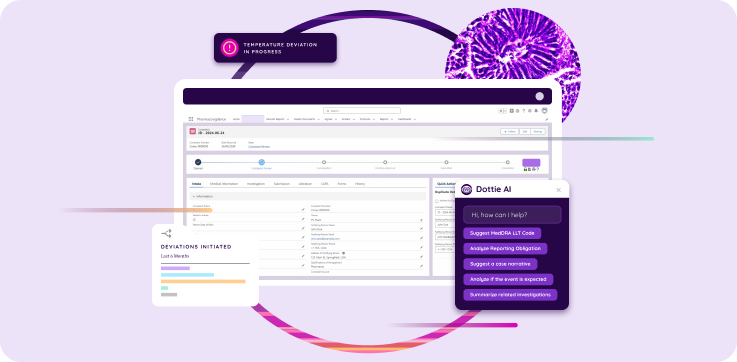
Our platform includes pre-configured workflows for document control, training management, change control, CAPA, complaints, audits, supplier management and more. Dot Compliance also offers Dottie AI, an embedded AI assistant designed to analyze quality data and support insight generation within regulated environments.
Dot Compliance itself is certified to ISO 9001:2015 for Quality Management Systems, ISO/IEC 27001:2022 for Information Security Management Systems, ISO/IEC 27017:2015 for Cloud Security and ISO/IEC 42001:2023 for AI Management Systems. These certifications demonstrate a commitment not only to product functionality, but also to secure architecture, responsible AI governance and operational discipline.
Dot Compliance is often selected by life sciences organizations seeking scalability, integration depth and modern architecture without the heavy customization burden of legacy enterprise systems.

SimplerQMS
SimplerQMS emphasizes structured workflows and positions itself around full validation alignment with GAMP 5. The platform integrates with Microsoft Office and includes validation documentation as part of its subscription model.
Its structured framework can appeal to organizations seeking a prescriptive, compliance-forward implementation. Companies requiring extensive customization or highly complex cross-system integrations may need to evaluate flexibility over time.
Qualio
Qualio is frequently selected by growth-stage medical device and biotech companies. The platform emphasizes usability, onboarding support and fast implementation.
Qualio includes core modules such as document control, design controls, training and CAPA. It uses a web-based document editor and follows a tiered subscription model.
For early-stage companies building foundational quality systems, Qualio can be a practical choice. Organizations anticipating rapid scaling or deep enterprise integration may need to assess long-term fit.
MasterControl
MasterControl is an established enterprise-grade quality management platform used by large pharmaceutical and medical device organizations.
The system supports comprehensive quality and manufacturing processes and offers configurable enterprise workflows. Implementation and configuration can be extensive, making it most suitable for large global enterprises with sufficient internal resources.
TrackWise (TrackWise Digital)
TrackWise offers both on-premises and cloud-based deployment, with TrackWise Digital built on Salesforce.
The platform supports enterprise configurability and integration with ERP, CRM, LIMS and MES systems. It is typically evaluated by large, complex organizations requiring highly tailored workflows.
Implementation complexity and cost should be weighed against organizational scale.
Ideagen Quality Management
Ideagen provides a modular eQMS platform serving regulated industries, including life sciences. It integrates with Microsoft Office and offers modules for document control, audits, CAPA and supplier management.
Validation services are typically structured as part of implementation engagements. Organizations should evaluate integration consistency across modules when assessing long-term scalability.
Greenlight Guru
Greenlight Guru is designed specifically for medical device companies and emphasizes design controls and traceability.
Its structured workflows align closely with ISO 13485 and FDA device requirements. It is frequently selected by medical device startups and growth-stage companies. Broader life sciences organizations should evaluate integration breadth if operating across multiple regulatory frameworks.
QT9
QT9 provides a cloud-based QMS platform with numerous modules and promotes comprehensive validation documentation.
The system integrates strongly within its own ERP ecosystem. Organizations operating outside that ecosystem should assess flexibility in external integrations.
Scilife
Scilife offers a cloud-based life sciences QMS with tiered subscription plans and Microsoft Office integration.
Validation documentation aligned with GAMP 5 is provided, though some validation activities remain customer responsibilities. Organizations should evaluate module inclusion at each tier when planning long-term scalability.
How to Select the Right Platform
Selecting an eQMS requires alignment between regulatory exposure, operational complexity and future growth.
Organizations should prioritize connected workflows, integration depth, scalability across sites and clarity around validation ownership.
The most common implementation failures stem from poor adoption or weak integration rather than missing features.
Final Thoughts
The best eQMS in 2026 is not simply the one with the longest feature list. It is the one that reduces administrative burden while strengthening compliance integrity and supporting long-term scalability.
Life sciences organizations must evaluate not only current needs but also where they will be in three to five years. Architecture, integration and validation transparency matter more than marketing claims.
We’ve created a checklist to help you make the right decision for your company. Download the checklist to start your shortlist today.